




by Forestville Montessori School
On August 31st, schools, staff, students and alumni around the world celebrate Dr Maria Montessori’s birthday as the founder of the Montessori movement.
On this day at Forestville Montessori School (FMS), we also celebrate our Founders, the visionaries who started our school. We’re now in our 43rd year providing an authentic Montessori education to families on the Northern Beaches.
Despite this deep history, tens of thousands of schools worldwide and a prime location on the Beaches, Montessori education and Forestville Montessori School remain something of a mystery to many people in our community. We’d like to clear that up!
You may be surprised to know that Montessori is one of the oldest education systems in the world, yet it delivers one of the most futuristic education systems on the planet.
It provides childhood experiences that are associated with higher rates of wellbeing in adults (Lillard et al., 2021), and blends extensive academics with learning that prepares children socially and consciously to become confident, contributory members of their communities.
Seen in this context, yes, Montessori is very different to mainstream!
That said, we still comply with relevant Government standards.
At Forestville Montessori school, we offer programs for parent/baby, toddler, pre-school and primary school. We’re accordingly registered with the Australian Children’s Education & Care Quality Authority (ACECQA) and NSW Education Standards Authority (NESA). Our degree qualified teachers are registered with these bodies and are also Association Montessori Internationale (AMI) trained – a feature that’s increasingly rare, even among Montessori schools.
Teachers, connection and trust
Most adults would agree that the relationships we had or did not have with our own teachers greatly impacted our attitudes towards school and learning.
In the Montessori system, a child will have the same teacher over a 3-year learning cycle. This provides time for teachers to build a relationship of care, connection, and trust.
We have higher teacher to student ratios and our teachers work with students in small groups, often 1:1, so every child receives personal attention, every day.
At FMS, your child’s teachers genuinely know your child. They understand their learning strengths, areas of need, and how to get the best from them in the learning environment.
This personal approach is a key element of Montessori learning, and a key different from traditional learning systems.
Higher academics, future wellbeing
The stability and strength of relationships in the Montessori classroom, including multi-age peer groups, may be linked to higher academic performance, positive social relationships, and a stronger sense of community (Lillard et al., 2021, p.4).
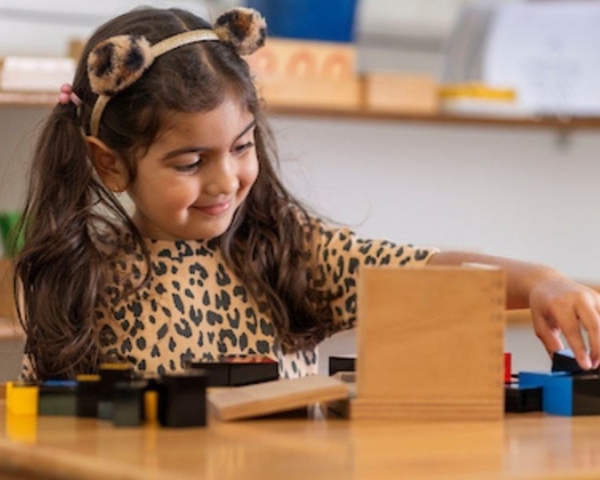
Our environments allow children to explore personal interests, use hands-on learning materials and collaborate often with peers. These foundational aspects of Montessori education differ from mainstream and are associated with predicted adult wellbeing and a range of other positive personal and social outcomes (Lillard et al., 2021, p.2).
They also happen to feature in the OECD’s vision for future education…
The future of education, right now at FMS!
We see these features in the OECD vision for education 2030, which offers ideas such as interconnectedness, project-based learning, and teaching ‘Big Ideas’ where students explore, observe and apply concepts across multiple disciplines. These ideas are features of the ‘Cosmic education,’ practical learning and collaborative work currently taught in Montessori schools and at Forestville Montessori.
The OECD recommends a future education that allows students to become critical thinkers, good problem solvers and to be able to develop the skill of “learning to learn” (OECD Learning Compass 2030, 2019).
These are the intended outcomes o Montessori learning materials and environments, which incite higher thinking and lifelong motivation for learning.
6 features of the future
If that’s not progressive enough, some more futuristic features of FMS education are the 6 elements predicted by the OECD to become the ‘new normal’ for education by 2030. They are:
- Shared decision making & responsibilities among all stakeholders
- Students as active participants in their own learning
- The learning process and student wellbeing is valued in addition to academics
- Different learning styles are recognised
- Different assessments are used for different purposes
- Frequent feedback informs improvements to education
Every one of these future features is a foundational element of the 100+ year old Montessori education system, all practiced daily at Forestville Montessori School.
We hope this makes Montessori a little less mysterious, and that you understand more about how we differ from mainstream education.
You can learn more about Forestville Montessori School and our programs via our website or book an online tour and come see us yourself!
You’re also welcome to join our parent education evening, Beyond Preschool, on Thursday September 5th. Register here: https://events.humanitix.com/montessori-beyond-preschoool