

Jasper Peach on Body Neutrality, Inclusive Language, and the Book That Holds Space for Everyone
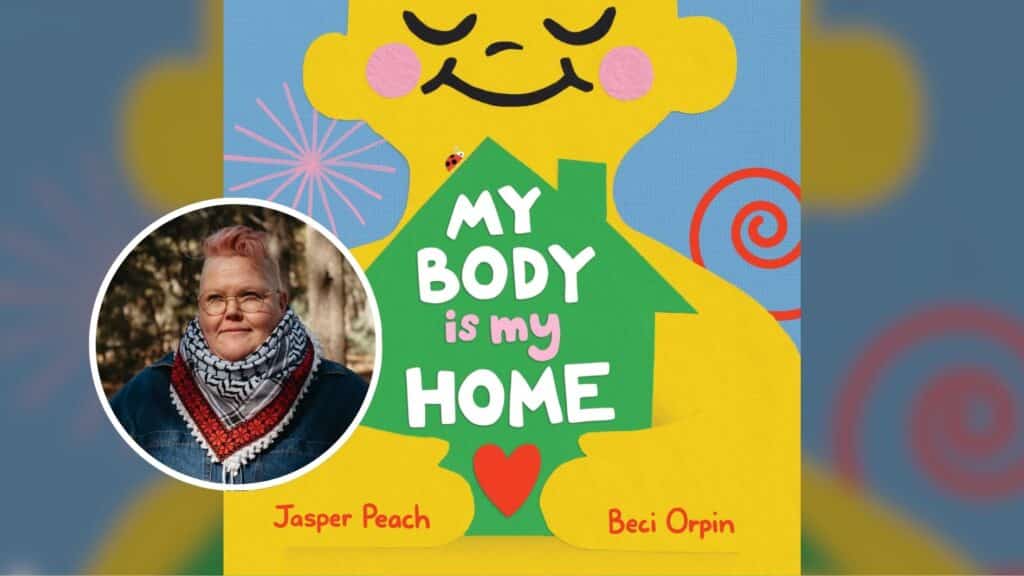
My Body Is My Home — the latest from Australian writer Jasper Peach, illustrated by Beci Orpin — arrives at a moment when conversations about body image are everywhere, and yet the simplest, most grounding idea of all keeps getting overlooked. Not body positivity, with its insistence on love and celebration, but body neutrality: the gentler, steadier notion that your body doesn’t need to be beautiful to deserve your kindness. Peach, who writes as a trans, non-binary and disabled parent, knows this distinction intimately — and has found a way to carry it into the hands of the very youngest readers, in language that holds everyone.
We sat down with Peach to talk about how that language gets made, what their own identity brings to the page, and the importance of the arts in building community. The conversation was warmer, sharper and more honest than we expected.
The title My Body Is My Home is such a warm and grounding metaphor. How did that central idea come to you, and what did you want children to feel when they first hear it?
There are so many ways these words and this concept landed in my life. The first was from a beloved friend and Wiradjuri poet Jazz Money. I’d run into them in my local library and we had a yarn about the research and creation project I was doing in children’s literature, funded by Creative Victoria. By that stage I’d cast aside the idea I’d had for the book I assumed I’d go on to create, finding that it already existed several times over.
I went a little deeper, then sideways, and found the quiet part inside of me that knew as a small child that life would be beautiful – I just had to keep going to get there. Discussing the ideas with Jazz, I was met with warm encouragement that these themes of embodiment, a sense of self and the notion of home, would work. Jazz texted me later with the profound gift of the title. From there everything fell into place.
I’ve since discovered that I’d used the phrase “my body is my home” in a spoken word piece a few years prior to that, and that this is also the name of a song by Electric Fields!
In the dedication page of My Body is my Home, there is a nod to Jazz Money. At a time when their beautiful illustrated story for children Bila – A River Cycle has been pulped by their publisher, it feels like another example of a white person (me) given the opportunity to thrive where a First Nations person is oppressed and harmed.
When children first hear the phrase “my body is my home” it’s my sincere wish that they feel flooded with a sense of joy and peace. Every child has a body, but not every child has a home that is safe. Children don’t have much control over their lives, but understanding the why and the what can be grounding and give a sense of narrative safety.
Writing about bodies for young children requires such careful, inclusive language. What was your approach to making every child feel seen without being prescriptive?
This is such a great question! I had big plans for how the artwork that came with the words would be inclusive, but the words themselves were carefully written, edited and rewritten, many times over. I worked with psychologist and author Dr Chris Cheers, nutrition scientist and author Dr Emma Beckett as well as a kindergarten teacher and a primary school wellbeing coordinator during my research. I also had the brilliant support of my writing mentor Myfanwy Jones. I had lovely meandering conversations with each person that helped me understand the best way to go about conveying what I wanted to get across. Being child-centric is what everything comes back to. What will make the most sense to a child?
I did run everything by my own children too, and they were both very helpful. They’re now aged 6 and 9 and were very impressed when a real life book appeared on our mantlepiece that their mum made.
Writing MBIMH was also born from the experience of writing about disability justice and rainbow families over the years. My first book was a parenting book for the LGBTIQA+ community, and I took great care in ensuring the work was accessible. I’d bought so many parenting books when we were creating our family and could never get past the first few pages of dense text that had nothing to do with my situation. The result was a book that made people feel safe and included, and I’ve used similar techniques to find the right ways to express things here. Mainly through talking about every angle with people who know more than me until I understand, then conveying the core messages of belonging and belief in one’s self.
There are multiple layers of the story – a friendly, cheerful layer, a reading between the lines layer for children who aren’t having a very good time, and a layer for the inner child of adults reading and sharing the story with young people. It’s a bit of a Trojan horse!
How did your collaboration with Beci Orpin shape the book? Were there moments where her illustrations took the concept somewhere unexpected?
Working with Beci was an absolute dream come true. I have admired Beci’s talents with message and accessibility for quite some time, and it was beautiful to collaborate on something that was so personal. We had a lot of discussions about what the words meant and how the imagery could convey that meaning, and there were a few easter eggs I wanted to put in there (the ladybug wearing a tiny hard hat for workplace safety on a scissor lift, for example).
Beci Orpin is a genius. The way she used collage to really make the images come to life, they feel like they’re leaping from the page into the arms of the reader. I knew there would be birds on one of the pages, and their positioning mid-flight as a flock took my breath away. We were both very receptive to one another’s ideas and had a wonderful experience with our publisher.
The main thing I wished for in the artwork was that every child would feel included – and to do that I suggested using bright colours and big shapes. Young readers have phenomenal imaginations, and I knew the beings that Beci designed would join forces with that imagination so every child could feel part of the story.
What age group did you have in mind, and how do you hope the book is used- at home, in classrooms, in therapy settings?
The idea first came about when my children would return home from kinder and say things like “I will grow up big and strong because I eat all my vegetables”. I have no dispute that eating veggies is a good thing to do when possible, but as a person with an energy-limiting disability I was a bit perplexed by the insinuation that came with that messaging. If a person isn’t physically strong compared to others, does that mean they’ve done something wrong?
It’s important for children to learn in ways that make sense to them, and sometimes the nuance of a message goes awry. This can lead to exclusion and judgement as they learn from everything they’re absorbing around them in the world. I wrote the book for children aged 3 – 6, and hoped it would be well placed in kindergarten, early childhood education and the first two years of primary school.
If MBIMH is used therapeutically, I would be thrilled! It’s been very therapeutic for me to create, and for that to ripple out would be dreamy.
Body neutrality is still a relatively new framework for many people. How would you explain it to a parent who’s only familiar with body positivity?
Yes! All parents are doing their best with what they have at their disposal. So much of how we were parented ends up coming out of our mouths, to great shock! Examining the messages we absorbed as children is so fascinating, and as we learn more about children’s brains and wellbeing, we can give our children resources and views that weren’t available to our parents.
Body positivity was a brilliant introduction to the discourse, encouraging people to love their bodies. Prior to that, there was right and wrong – with most bodies falling into the wrong side of things.
A more inclusive framework is now available to us in body neutrality. What that means is a body is neither good nor bad, it just is. Body positivity inadvertently placed pressure on people to feel happy about everything, which isn’t really possible or accurate. For example, I experience chronic pain and I’m not jumping for joy over the pain parts. However, my body is round and plump, and those are neutral descriptors. I don’t have to insist that they’re wonderful and brilliant, I can approach my body with the notion of being at peace with all that I am.
Body neutrality also weaves in the notion of an impulse many people have which is to first comment on how a person looks. I love that dress, you’re such a pretty girl, what a big strong boy you are. This indicates to children that our value lies in the cosmetic rather than what our hearts are like. Body neutrality returns the focus to how we feel inside, away from a hierarchy of a good body or bad body.
The shapes and sizes, abilities and capacities of bodies are often out of our control – especially for children. Placing value on something we have no way to change indicates that it’s important to do the impossible in order to be loved.
Children absorb everything adults say to each other and themselves, so body neutrality for parents is important for children’s wellbeing.
Some body neutral statements to try:
I’m going for a walk to get some fresh air and to give me some energy.
Your body is so good at knowing when you’re too hot or too cold! Or – My body feels very warm after all that playing, I’m going to take off my jumper and have a drink. How is your body feeling?
My arms help me hug all the people I love, and I love you. Would you like a hug? We could also wave, shake hands or do a high five. It’s your decision because it’s your body.
Our bodies need rest at night, and that’s why we’re going to relax and get ready for sleeping.
Do you think body neutrality is easier to introduce to children than to adults? Is there something about young minds that’s more receptive to it?
Definitely. It can be so difficult to disentangle old habits, but kindness and self-compassion are very useful parts of a parenting toolbox. When children are learning from their peers and carers, they’re noticing everything. The energy shifting in a room when someone is grumpy, facial expressions, tone of voice, sometimes these elements have greater impact than the words themselves.
Naming how we feel when things change can help children feel very secure, and become more securely attached. For example “Gosh, I feel tired all of a sudden, and a bit grumpy! I think it’s a good moment for us to have a snack, then will we have a relax and a cuddle?” When we don’t have to guess why something has changed, it helps children to feel secure and sure of their belonging.
Children arrive without years of experience like parents have, and it’s so important to be compassionate with ourselves about what we’re teaching them and how we’re going about that. When a child is born, so is a parent or carer. We learn together, and if we’re not our best selves in a moment (usually due to exhaustion or overwhelm), it’s never too late to make amends. Modelling that it’s normal to apologise to our children will teach them so much. Genuine forgiveness from a child means so much, because they generally have no reason to pretend.
Where do body neutrality and body positivity complement each other, and where do they diverge?
Oh this is a lovely question. There are deep distinctions between body positivity and body neutrality, as movements and as ways we interact with ourselves and others. We emotionally invest in appearance when it comes to body positivity, whereas body neutrality is about a body’s functionality and doesn’t require emotional positivity. I feel that body positivity led to body neutrality, because the more we learn – the more we learn! One was a stepping stone to the other, and both are vital components of coming to understand how we relate to humanity.
Your own identity as a trans, non-binary and disabled person clearly informs your writing. How much of yourself do you consciously bring into a book aimed at young children?
It’s so interesting to think of how children regard me in terms of identity. Most children don’t blink an eye and accept that I know myself well enough to describe my name, gender and pronouns. This is the same with having a dynamic disability – sometimes I use a walking stick, sometimes I don’t. Children are naturally curious and will ask why – and they’ll do so in a very neutral way. When I explain in a way that makes sense to them they agree and then ask what my favourite dinosaur is, or if we can put more pink glitter on our collage now. At a time in their lives when there is so much learning every day, things that make sense are filed away as they prepare for the next new piece of information.
The only time children are suspicious or display any negative type of reaction to me is when this is something they’ve learned from important adults in their lives. I don’t contest their beliefs, and hope that as they grow they’ll get to know all sorts of people. To be a child growing up in an environment critical of those outside the narrow experiences or identities understood to be acceptable can be deeply unsafe, and I’m thinking of children who need to conceal their own understanding of who they are until they know they’ll be loved and accepted for all that they are.
I feel the same about children who are raised to distrust people from different racial backgrounds to their own. My hope is that they’ll have opportunities to meet people different to them and make up their own minds.
I think what I bring most of all is curiosity, an awareness that I don’t know everything, and that being inclusive is deeply aligned with my values. Once the book is out in the world, I have no idea who will pick it up. But I do know that I want every single reader to have a good experience when they do.
What do you wish had existed for you as a child, such as a book, a phrase, a framework- that My Body Is My Home might now offer to someone else?
There were many examples in literature and media about children like me who felt different, but they were not specific. Or when they were, it was about something that wasn’t possible to change and the main messaging was that the child who was different just had to accept that people wouldn’t like them or include them. That even though the bully, for example, would continue what they were doing, the child had to hold their head up high. It was very confusing.
This is changing now, with so many neutral inclusions of all sorts of people across narratives. I think until marginalised minorities are accepted and given equal footing, it’s important to have stories about specific identities framed within narratives. Neurodivergent people, people living in bigger bodies, disabled people and anyone that experiences a lack of equity in life due to systems and harmful beliefs held by the majority.
Part of the reason I got into writing was that the page was a place that I was in charge of what happened. I could write the most fantastical things about living in the world in my body, and nobody could change that except me during the editing process. Having narrative control and being playful are both deeply therapeutic devices that I encourage all of my writing mentoring clients to tinker with.
To think back to the 1980’s, the stories I wished could exist wouldn’t have made sense in that time. We didn’t understand then what we have come to understand now. They’re all stepping stones, the stories from back then to the stories we get to tell now. Having said that, I loved the Babysitters Club books by Ann M Martin, where there was implied identity politics that I could enjoy swimming around in.
What would you want policymakers to understand about the ripple effects of cutting arts funding that perhaps aren’t immediately visible?
I think policymakers do understand the ripple effects of cutting arts funding, which is what makes decisions made in recent times so horrifying. The impacts aren’t abstract, they move quickly through economies, education systems, and communities.
The arts are not and never have been a discretionary extra. They shape how we relate to one another and make sense of the world. When funding is cut, small and medium organisations fall first, and the independent artists and sole traders who sustain the sector are left without stability. These are the people responding in real time: creating context, connection, and meaning.
What often goes unseen is how quickly this erosion compounds. Opportunities shrink, diverse voices that accurately represent humanity disappear, and entire pathways into creative practice become inaccessible. In regional areas especially, arts funding is a lifeline. It enables communities to express identity, maintain connection to wider cultural conversations, and feel less isolated from metropolitan centres.
When arts funding is cut, the social fabric that holds communities together frays and disintegrates. Where does that leave us? Why is funding to the arts being cut now, and what is being funded and perpetuated in its place? The answers are deeply disturbing, and the best way to respond would be with creative expression that will contextualise what the gutting of the arts sector means to everyday people, our freedoms and wellbeing.
My Body Is My Home by Jasper Peach, illustrated by Beci Orpin is out April 28, 2026. Order your copy now at Allen & Unwin.