





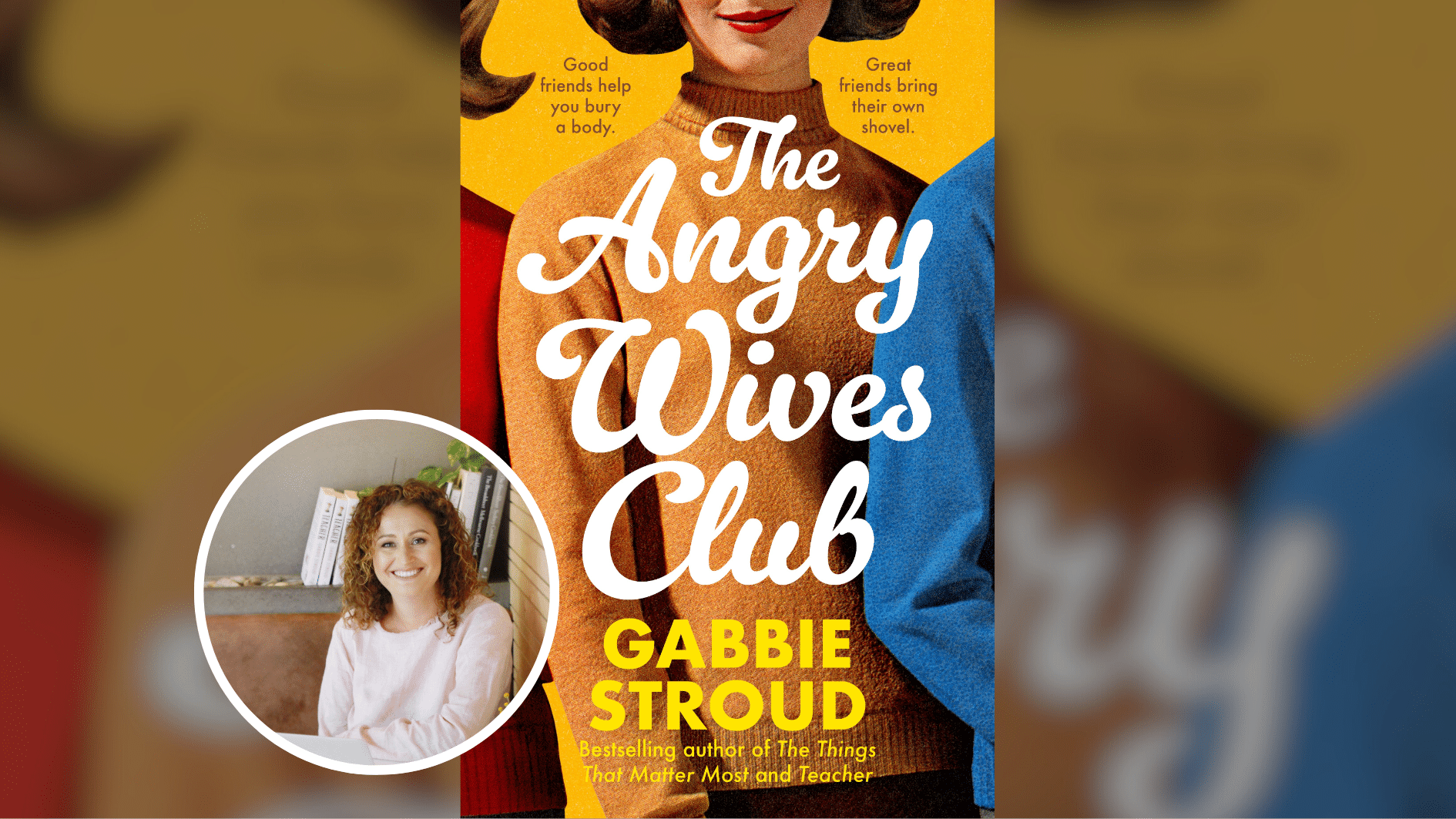
Some books arrive quietly. Others announce themselves. The Angry Wives Club — the latest from Australian writer Gabbie Stroud — belongs firmly in the second camp.
Best known for her memoir Teacher, a searingly honest account of burnout and the slow unravelling of a career she loved, Stroud has spent the years since proving her voice is anything but a one-story wonder. But this new novel feels like a different register entirely: fiercer, funnier, and rooted in the kind of truth that tends to live quietly in women for a very long time before it finally demands to be heard.
In the lead-up to release, we sat down with Stroud to talk about the personal reinvention that preceded this book, the conversation with her daughters that became its unlikely spark, and why female rage might just be one of the most underexplored forces in contemporary fiction.
Q: You left teaching, your husband and your book agent all at once to take up a career in writing fiction. There’s a saying that big change comes in threes – did yours feel like a coincidence or were they all connected at the root?
A: Well, first up, let me be painfully honest and admit that two of those departures weren’t really executed as strategic, well thought out manoeuvres! I left teaching and my marriage in the same way a drunk leaves the pub – staggering aimlessly with a desperate hankering for a kebab! I was much more deliberate and thoughtful in leaving my agent.
I think my experience with divorce and a career change has taught me to add a good dose of planning and preparation to any passionate decision making.
Were these changes all connected at the root? I’d have to say yes because with each of those choices, I was attempting to arrive somewhere closer to myself, to my truth and to a lived expression of my life that feels authentic for me. (That makes me sound like a bit of a wanker! Please stay with me, I’m not a complete tool!!)
Q: Leaving teaching behind was clearly a huge part of your reinvention. How has your years in the classroom shaped the kind of writer you’ve become?
A: Love it when people describe me as having reinvented myself. Makes me sound like Madonna!
When you’re a teacher you gain a unique perspective into other people’s lives; children, their families, relational dynamics, personalities and preferences. When I first started teaching, I kept being surprised at the insights I was having into how ‘other people’ lived.
Then over the years, I gained greater awareness of privilege, power, control, culture, poverty… so many varying factors that impact our experience of the world. When I’m writing, I think I’m drawing on that understanding that I gained in the classroom – there’s many different ways to live a life. We’re all having vastly different encounters on this planet even though we’re all here to do the same thing.
Q: You’ve spoken about a conversation with your teenage daughters planting the seed for this book. What was it about that moment that stopped you in your tracks?
A: Yes – we were in Aldi and it stopped me and my trolley in our tracks! My youngest daughter (early highschool) told me a boy had mooned the class. I’d laughed and felt relieved I wasn’t teaching but my eldest daughter (mid highschool) said “That’s assault, call it out.”
And I felt my whole body had a reaction to that statement. It was like I just knew, right in the deepest parts of myself, that she was absolutely correct. And then it was like my body and my mind kept remembering all the times I’d overlooked bad behaviour by men and boys just to keep the peace or not cause a scene.
So many times I’d felt unsafe or uncomfortable by things men were saying or doing but I didn’t speak up or take action. And then I realised how much that had hurt me and how much it had cost me.
Q: Which authors have shaped you most as a writer and has that list changed as your own writing has evolved?
I want to write the same kinds of books that I love to read – books that have characters I love and stories that make me think. Daphne Du Maurier and Maeve Binchy were the first of these kinds of authors I encountered when I was younger. Daphne wrote Rebecca and I thought it was so clever that we never discovered the main character’s name! And Maeve had me for life with Circle of Friends.
Nowadays it’s Liane Moriarty, Sally Hepworth, Holly Wainwright… a bit of Sulari Gentil if I’m in the mood for a murder and Helen Garner if I need some non-fiction. Oh and do not get me started on Taylor Jenkins Reid. She can do no wrong. I’m reading Atmosphere right now and I swear to God, every moment of my life right now, I’m just killing time until I can continue reading that book. She builds the most captivating worlds!
Q: You’ve written across very different genres. Is there a genre you haven’t tried yet that secretly piques your interest?
A: Poetry. There’s such restraint in poetry. I wish I knew how to write like that!
Q: What’s the hardest part of the writing process for you- the blank page, the messy middle, or the endless editing at the end?
A: I learned with The Angry Wives Club that I make writing hard for myself when I re-read, mid-draft and then start tinkering and editing. I lose all momentum, I find myself stuck and I make zero progress. So, I guess that’s the messy middle of a first draft. I know I’ve got to keep writing forward without stopping to look back.
Q: The Angry Wives Club is such a powerful title. Where do you think female rage really comes from- and why does it so often go unspoken until midlife?
A: Wow – what a question. I’ve done lots of work with my psychologist about various feelings and I’ve reached the conclusion that anger and rage are built on earlier less volatile emotions. My shrink actually says “resentment sits on a pile of unmet needs”.
So if you follow that thread – resentment builds to frustration which builds to anger which then builds to rage. Again, if we follow that logic, our rage remains unspoken until midlife because it’s still building. I also think by midlife you’re big enough to see behind the velvet curtain. You realise that so many of the things governing you are constructs made by the patriarchy and you’re big enough, and have enough lived experience, to be courageous and speak back to that idea.
Also – hormones.
Q: There’s so much that women carry quietly, like the mental load, the emotional labour, the slow erosion of putting everyone else first. Did writing this book feel like a way of finally putting that down?
A: This book made me really examine that load, so in a way I didn’t put it down. I picked it up and took a good long look at it. Writing this book coincided with me meeting a man who I went on to marry. As well as being a wonderful ‘falling in love’ adventure, meeting this guy also opened my eyes to the way many men simply choose not to engage in any of the load-bearing that women are expected to carry.
Even before we married, I could see this man I’d met was capable and willing to manage everything that was required to be in a relationship, to be a father and to maintain a home. He had a home full of houseplants, he cooked for himself, he cared for his elderly father. It made me really angry actually! I started thinking “Well, if he can do it, what’s stopping all these other jokers?”
Q: Is the club in the book a fantasy, a reality, or a little bit of a love letter to the friendships that got you through?
A: What a great question! I think it’s a battle cry for female friendship. You know, like, “Rally the troops girls! Solidarity! We’ve got each other!”
Q: If the Angry Wives Club existed in real life, would you join- and who would you bring?
A: I’m actually kinda nervous that a club is going to start as a result of this book! Of course I’d join. I’d probably over commit and offer to do the fundraising. I’d bring my best friend Natalie. She’s the one who knows where the bodies are buried… and the next names on my list!
The Angry Wives Club by Gabbie Stroud is out March 31, 2026. Order your copy now at Booktopia.