




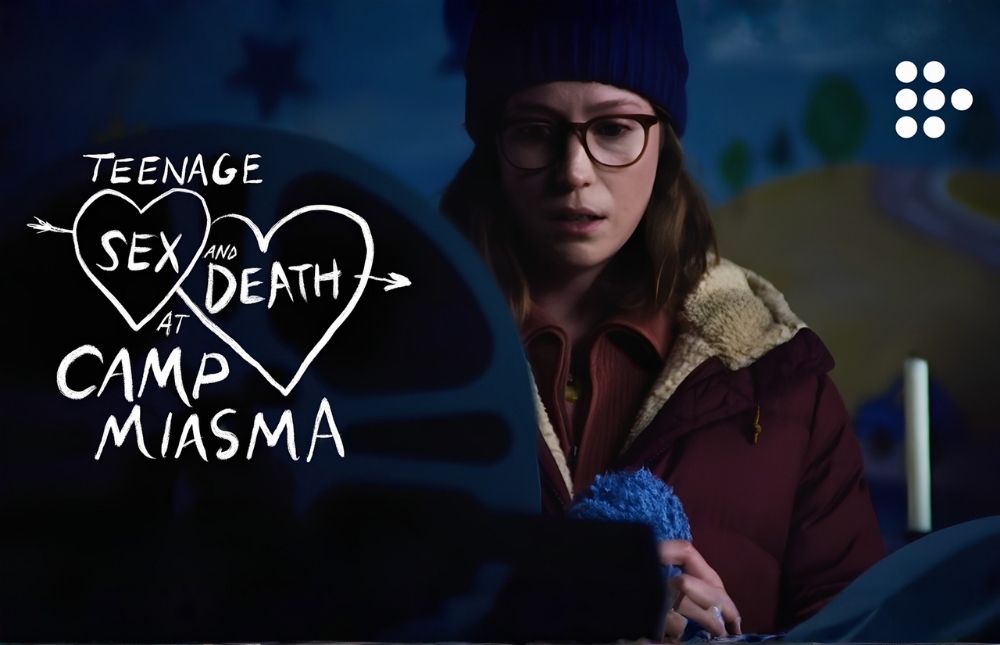
Jane Schoenbrun’s Teenage Sex and Death at Camp Miasma (a title I am scared to Google search out of fear of being put on some kind of list) is a beautiful and hilarious film that offers a moving study of how cinema shapes identity and connection.
Premiering in May at the Cannes Film Festival, where it took home the Queer Palm award, the film follows young director Kris, played magnificently by Hannah Einbinder, who is hired to direct a reboot of the fictional horror franchise Camp Miasma.
Kris travels to a rural alpine area to meet with Billy Presley (the always excellent Gillian Anderson), the reclusive star of the original Camp Miasma film, and the pair enter into an intriguing and erotic creative partnership. Like Schoenbrun’s previous two films, the eerie We’re All Going to the World’s Fair and the harrowing I Saw the TV Glow, Teenage Sex and Death at Camp Miasma explores identity, albeit in a much lighter way than those prior entries in Schoenbrun’s filmography.
Instead of approaching the concept through an explicitly queer lens and focusing on the existential horror of rejecting one’s own queer identity, the foundation of Schoenbrun’s film is the belief that the acceptance of one’s own sexual identity and sexual desires allows an individual to rise above everyday horrors and become a well-rounded and liberated being. Cinema, and the interpersonal connections borne of it, is positioned as the source of this liberation. Kris first experiences sexual desire while watching Presley in the original Camp Miasma as a child. The connection she has to the actress is what shapes not only her desires, but her entire identity as a queer person. The sexual, romantic, and creative relationship that starts between the pair serves as an affirmation of Kris’ identity and desires and allows her to let go of her shame surrounding her sexuality.

Schoenbrun posits that cinema makes us view desire and identity from an outside perspective, and allows us to better understand how they appear within ourselves and within others. Such a cerebral concept would be difficult to translate to screen were it not for the incredibly high calibre of the actresses representing it.
Einbinder is truly exceptional as the lead and her ability to portray the ever-increasing confidence of Kris as she comes into herself through her relationship with Presley is nothing short of masterful. Anderson is similarly fantastic and manages to avoid making her role as an object of desire flat and one-dimensional, instead focusing on the character’s depth and making the secretive actress even more alluring by focusing on her rich inner life.
The film is formally and technically masterful too. The cinematography is beautifully composed, particularly through how it captures the warmth found in Kris and Presley’s blossoming relationship, creating images that will stay with you long after the film is over. The production design is absolutely excellent too, especially in how it uses sets to differentiate between the film itself and the film-within-the-film, Camp Miasma, creating sleek, seamless, and refined sets for the former and janky and low-budget ones for the latter, adding an authenticity to Schoenbrun’s film that allows it to connect with its audience more directly. The film’s editing is also magnificent, using brief moments of discontinuity to make the viewer pause and reflect on the ideas that Schoenbrun is exploring.
While Teenage Sex and Death at Camp Miasma is certainly not a film appropriate for young children to see, its incredibly earnest and profound exploration of identity and self-acceptance is sure to resonate with both older teenagers and adults, and will hopefully allow them to meaningfully reflect on their lives and identities.
Watch Trailer