



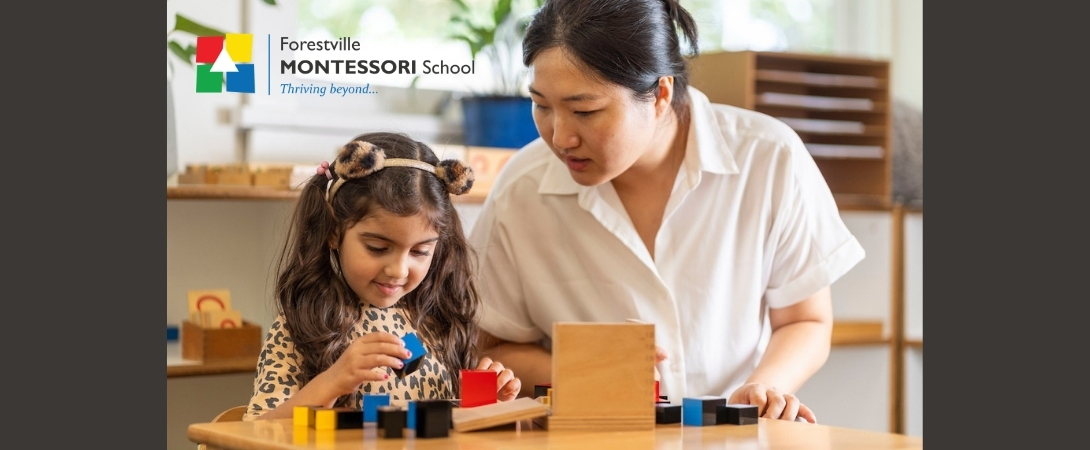
Curious about Montessori?
If you’re seeking a personal education that prepares your child academically, socially, and responsibly, to become a capable person engaged with learning and with life, then Montessori may be for you!
Montessori is named after Dr Maria Montessori, an Italian scientist, medical doctor, and educator. Developed in 1907, Montessori education is now practised in more than 15,000 public and private schools across 154 countries around the world, supporting children from birth to eighteen years.
Grounded in practice and observation
Montessori education is backed by more than a century of practice and observation of hundreds of thousands of students globally. The Montessori model is more relevant today than ever, aligning with the modern emphasis on engaging, individualised, personal and self-paced learning.
Montessori is grounded in our understanding of childhood development. It supports executive function, academic achievement, curiosity, imagination, and a love of learning.
The key characteristics of Montessori Education are:
- Student choice: Children choose purposeful activities prepared by trained Montessori teachers.
- Mixed-age groups: Children learn with and from peers in the same developmental stage, building confidence, leadership, and community.
- Uninterrupted work periods: Children build focus, concentration, independence, and persistence.
- Hands-on materials: Concrete, self-correcting materials support curiosity and self-guided learning.
- Comprehensive curriculum: Learning includes language, maths, science, culture, art, music, movement, practical life, and social development.
- Personalised learning: Lessons are given one-on-one or in small groups, matched to each child’s readiness.
- Developmental stages: Montessori changes with age because it follows children’s natural development.
These fundamental characteristics of Montessori learning align with the OECD’s 2030 vision for education, which highlights the following key principles for learning in the future:
- shared decision making
- students participate in their learning
- the learning process and wellbeing matters as well as academics
- different learning styles are recognised
- different assessments are used for different purposes
- feedback supports ongoing improvement
This vision for future education is part of everyday life, right now, at Forestville Montessori School!
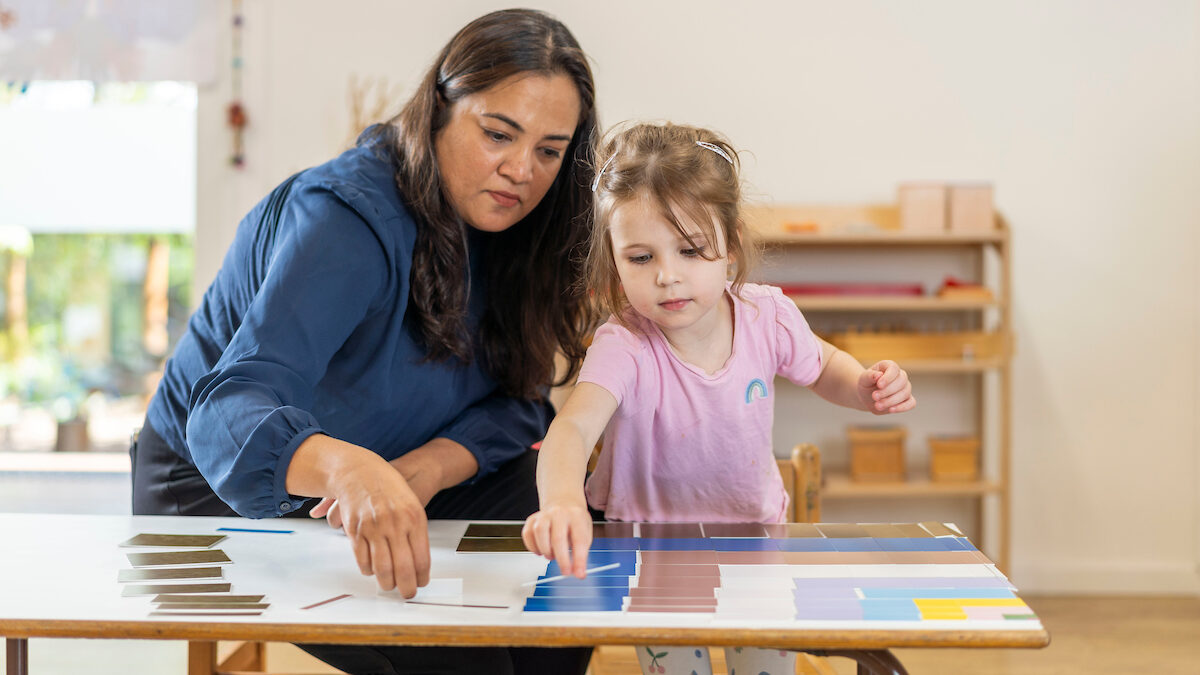
What does learning look in a Montessori Classroom?
In Preschool and Primary school, Montessori education is guided by careful observation of each child.
The classrooms are calm, orderly, and prepared with hands-on materials that invite curiosity, concentration, independence, and exploration.
Children receive individual or small-group lessons, then choose meaningful follow-up work to practise, repeat, extend, and take responsibility for their learning.
Mixed-age classes support peer learning, leadership, collaboration, and respect.
Classrooms are purposefully prepared to support this style of learning. This is called the prepared environment and includes set-up, layout, materials and the teacher.
Montessori teachers observe, guide, and support each child’s exploration of the materials and environment, rather than dictating information.
At Forestville Montessori School, educators in preschool and primary school are degree qualified teachers with additional Association Montessori Internationale (AMI) Diplomas. They are supported by AMI trained classroom assistants. Together, they provide some of the most authentic Montessori education in Sydney and adhere to NSW Government requirements for early learning & primary education.
What do Montessori Preschoolers learn?
Preschool students use beautiful sensorial materials to develop early literacy and mathematical thinking, exploring art, culture, geography, and science.
They engage in practical and social activities such as caring for plants, for belongings and for their environment, building care, confidence, independence, and joy in activity.
What about Montessori Students?
In Primary, students have a growing capacity for reason, imagination, curiosity, collaboration, and moral awareness. Montessori Primary School provides space and time to nurture these developmental needs.
Lessons expand ideas in language, mathematics, science, history, geography, culture, art, and music, with follow-up work that allows children to investigate deeply and independently.
Work may range from practising mathematical skills to creating models, writing stories, conducting research, planning excursions and activities beyond the classroom. Children record their work, reflect with teachers, and learn to balance freedom with responsibility.
Outcomes include strong literacy and numeracy, understanding of the interconnected natural and human world, and skills in inquiry, collaboration, communication, and independent learning.
Still more at Forestville Montessori!
Forestville Montessori School’s unique NESA-accredited Kindergarten program prepares 5-year-old students for primary learning and supports a smooth transition from preschool to ‘big’ school.
They offer a thriving Montessori Toddler program for 2–3 year-olds and parent-baby programs on site.
Still curious?
Visit Forestville Montessori School for Open Day on Saturday 22 August, 10am–12pm, and stay for the Principal’s Presentation: Montessori & Gifted Education.
Register here: https://events.humanitix.com/fms-open-day-2026